Lenskart, founded in 2010 by Piyush Bansal, has become a popular brand in the Indian eyewear industry. What started as an online-only platform has now grown into a global brand with over 1300 stores across India and international markets. The secret behind this exponential growth? A powerful combination of technology and performance marketing. This article explores how Lenskart’s performance marketing and tech innovation have helped the brand scale rapidly and sustainably.
Lenskart was born out of a simple yet powerful idea: to make high-quality eyewear accessible to every Indian, regardless of their geographical location or income level. In a country where millions suffer from uncorrected vision due to lack of access or affordability, Lenskart saw a massive opportunity.
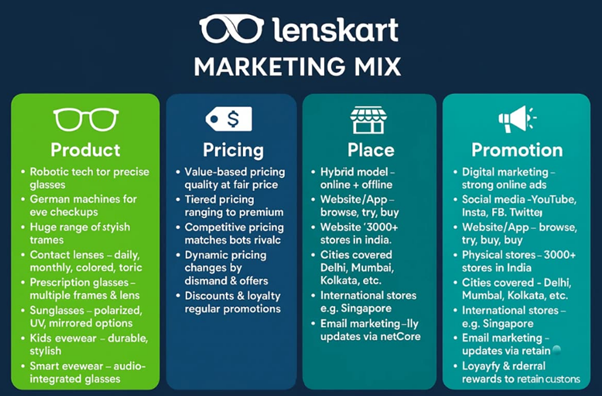
Source – Startuptalky
Piyush Bansal, the founder, envisioned a tech-first eyewear brand that could disrupt the traditional optical retail model. He realised that the eyewear industry was ripe for innovation, dominated by unorganised players, inconsistent pricing, and poor customer service.
• Affordability without compromise: Lenskart introduced stylish, durable eyewear at prices starting as low as ₹999, making it accessible to the masses.
• Omnichannel accessibility: The brand combined the convenience of online shopping with the trust of offline stores, creating a seamless customer journey.
• Customer-centric innovation: Services like home eye check-ups, free trials, and 14-day return policies were designed to remove friction from the buying process.
• Lenskart now serves over 3000 customers daily.
• It has expanded to 1300+ stores across India and abroad.
• The company is valued at over $4.5 billion, making it one of India’s most successful D2C brands.
This strong foundation set the stage for Lenskart’s performance marketing and technology as key growth accelerators.
Lenskart’s rapid scale-up wouldn’t have been possible without its deep investment in technology. From backend operations to customer-facing features, tech is embedded in every layer of the business.
Traditionally, retail expansion relied on intuition and basic market research. Lenskart flipped the script by using AI and machine learning to identify high-potential store locations.
• Data-driven site selection: AI models analyse foot traffic, income demographics, competitor presence, and historical sales data to predict store performance.
• 95% accuracy in revenue forecasting: This precision has allowed Lenskart to open 50+ stores per month with confidence.
• Reduced payback period: New stores now break even in just 8 months, compared to the industry average of 18–24 months.
Buying glasses online can be tricky. Lenskart solved this with its 3D virtual try-on feature.
• Facial mapping: The tool scans the user’s face and overlays frames in real time, helping customers visualise the fit and style.
• Reduced returns: This feature has significantly lowered return rates, improving profitability.
• Increased conversions: Customers complete purchases when they can “try before they buy.”
Managing inventory across 1300+ stores is not a small task. Lenskart uses AI to streamline its supply chain.
• Real-time inventory tracking: Ensures that stock levels are always optimised.
• Automated restocking: Predictive analytics forecast demand spikes and automate replenishment.
• Reduced wastage: Smart forecasting minimises overproduction and dead stock.
Lenskart has invested in a fully automated eyewear manufacturing facility in India.
• Robotic lens cutting and fitting: Ensures precision and speed.
• Custom orders at scale: This enables the brand to fulfil personalised orders within 24–48 hours.
• Cost efficiency: In-house production reduces dependency on third parties and improves margins.
These innovations have made Lenskart not just a retailer but a vertically integrated tech company.
Also Read- Gucci Goes Desi: Alia Bhatt’s Cannes 2025 Appearance a Marketing Win
While technology built the infrastructure, Lenskart’s performance marketing fuelled the brand’s visibility and customer acquisition. Performance marketing focuses on measurable outcomes, including clicks, leads, conversions, and ROI, making it an ideal choice for a fast-scaling D2C brand.
Lenskart utilises customer data to run highly targeted ads across various platforms, including Google, Facebook, Instagram, and YouTube.
• Behavioural segmentation: Ads are tailored based on browsing history, location, and past purchases.
• Lookalike audiences: Lenskart creates profiles of high-value customers and targets users with similar characteristics.
• A/B testing: Multiple ad creatives are tested simultaneously to identify the best-performing versions.
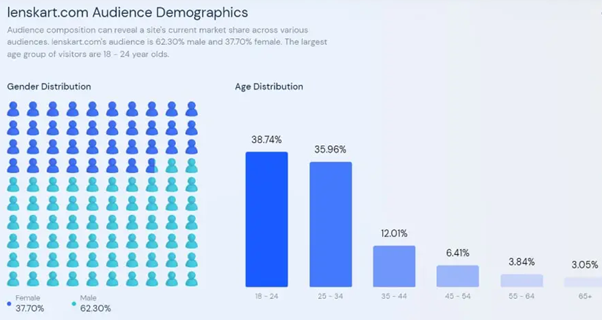
Source – digital scholar
Cart abandonment is a common issue in the e-commerce industry. Lenskart addresses this with smart retargeting.
• Dynamic product ads: Show users the exact products they left behind.
• Time-sensitive offers: Discounts and limited-time deals encourage quick conversions.
• Multi-platform retargeting: Users are retargeted across email, social media, and display networks.
While paid ads drive quick wins, Search Engine Optimization ensures long-term visibility and credibility.
• Keyword optimisation: Product pages and blogs are optimised for high-intent keywords.
• Content marketing: Educational blogs on eye care, frame styles, and lens types attract organic traffic.
• Local SEO: Helps users discover nearby Lenskart stores via Google Maps and search.
| Metric | Value |
| Daily customers served | 3000+ |
| Monthly website visits | 100,000+ |
| Conversion rate | 6.5% |
| Market share in India | 41% |
| Social media followers |
5M+ across platforms |
There is no denying that Lenskart understands the importance of social media marketing. Lenskart has successfully utilised platforms such as YouTube, Instagram, Facebook, LinkedIn, and Twitter. Did you know? Lenskart receives 53.4% of its traffic from YouTube (Latterly.org).
Facebook is another crucial platform where Lenskart has a massive following. Facebook brings about 20% of Lenskart’s overall website traffic. Along with Facebook and YouTube, Lenskart has also developed strong brand awareness and customer engagement. On Instagram, Lenskart engages with the audience through visual content. Also, their presence on LinkedIn and X shows their commitment to maintaining a strong social media presence.
Social media has become a crucial aspect of Lenskart’s performance marketing, enabling the brand to connect with millions of users across platforms such as Instagram, Facebook, YouTube, and Twitter. Lenskart’s strategy extends beyond simply posting product images; it’s about storytelling, engagement, and building a lifestyle brand.
Lenskart has partnered with high-profile celebrities, including Katrina Kaif, Bhuvan Bam, and Karan Johar, to amplify its brand message.
• Massive reach: Celebrity campaigns generate millions of impressions, helping Lenskart reach new audiences quickly.
• Trust and credibility: Endorsements from well-known personalities build consumer trust, especially in fashion and lifestyle segments.
• Cross-platform impact: These campaigns are integrated across TV, digital, and print, creating a unified brand presence.
Lenskart doesn’t just advertise; it engages.
• Polls and quizzes: These interactive formats help users find the right eyewear style and keep them engaged.
• AR filters and virtual try-ons: Social media filters enable users to try on frames virtually, thereby increasing the time spent on the brand’s page.
• Behind-the-scenes content: Videos showing how glasses are made or styled help humanise the brand and build transparency.
UGC is a powerful tool in Lenskart’s marketing arsenal.
• Customer reviews and photos: Real users sharing their Lenskart experience builds authenticity.
• Contests and hashtag campaigns: Campaigns like #MyLenskartLook encourage users to share their style, creating organic buzz.
• Influencer amplification: Micro-influencers help Lenskart reach niche audiences with high engagement rates.
| Platform | Followers (approx.) | Engagement rate |
| 1.2M+ | 4.5% | |
| 2.5M+ | 3.8% | |
| YouTube | 500K+ | 5.2% |
| 150K+ | 2.1% |
Lenskart has executed a series of successful marketing campaigns to improve its brand awareness and enhance brand recall. Here are a few examples of Lenskart’s performance marketing campaigns.
This is one of the most popular campaigns by Lenskart, featuring popular filmmaker Karan Johar and Lenskart CEO Peyush Bansal. This campaign increased awareness about the fair pricing of eyewear and eliminated the misconception that high-quality eyewear can be expensive.
The use of humour and relatable scenarios have made the campaign engaging to the target audience. It has helped in building a brand recall. The campaign got widespread attention on social media.
Lenskart grabbed the attention of its users with the IPL-themed marketing campaign. This campaign focused on Lenskart’s AR feature, allowing users to try on the eyeglasses virtually. Using the popularity of IPL and showing innovative technology, Lenskart enhanced brand awareness and engagement among thousands of cricket lovers.
The ad campaign focused on the topic of mishaps that can happen due to poor sight. Lenskart’s hilarious take on solving issues that might originate due to poor vision included some hilarious IPL moments to promote the importance of good vision.
The #Halkarakhyaar campaign brought Lenskart’s AIR eyewear to limelight. Through humour, Lenskart connected with its audience, focusing on the lightness and comfort of the eyewear. This Lenskart performance marketing campaign worked well with their audience seeking lightweight and fashionable eyewear. It enhanced Lenskart’s brand recall.
This campaign was the first set of TVC ads in collaboration with Bhuvan Bam as Lenskart’s brand ambassador. The focus of the campaign was the AIR eyewear, where a series of funny ad films were shot.
This was Lenskart’s attempt to promote freedom and inclusivity. Starting conversations and celebrating diversity, Lenskart successfully engaged a wider audience. It showed its commitment to social causes. Lenskart’s Pride Campaign not only created awareness but also showed that Lenskart stands for equality.
These Lenskart performance marketing campaigns showed how the brand engages its audience with impactful and effective messages. This led to higher awareness and brand recall among consumers.
Utilising technology, strategic partnerships, and a clear understanding of consumer preferences, Lenskart has successfully established a significant market share for itself. Speaking of offline presence, Lenskart has over 500 profitable stores across 120 cities. With its extensive network, Lenskart provides easy access to a wide range of eyewear products.
However, the disruption of the eyewear market by Lenskart is not restricted to its offline presence. The company’s website receives more than 7 million monthly visitors (Hyperstat). This shows its strong online presence. Ensuring a hassle-free and seamless online shopping experience, Lenskart has successfully adapted to the changing customer behaviour. This has helped them to capture a large section of the online eyewear market.
One of the crucial elements of Lenskart’s success includes strategic partnerships. Their collaboration with Ditto has transformed the online eyewear shopping experience. Ditto is a virtual reality tech startup from California. This collaboration increased website traffic.

Source – digital scholar
Also, Lenskart’s collaboration with logistics like BlueDart and Delhivery has strengthened its position in the market. To ensure quick and secure delivery, Lenskart offers efficient logistics operations, improving customer satisfaction and loyalty.
Another key aspect of Lenskart’s disruption model is the focus on product innovation. The company introduced innovative products, such as “Lenskart Blu”. This was aimed at protecting the eyes from harmful UV radiation. Also, “Airflex”, another innovation by Lenskart, offered ultra-light, unbreakable, and super-flexible glasses. These innovations not only targeted the evolving needs of the consumers but also positioned Lenskart in the competitive market.
Lenskart’s performance marketing strategy plays a crucial role in disrupting the industry. As we mentioned earlier, celebrity endorsements featuring brand ambassadors like Bhuvan Bam and Katrina Kaif have enhanced the brand’s appeal among the younger audience.
The inventory-based business model Lenskart focuses on offering high-quality frame designs and a wide array of lenses. The German-imported robotic technology for precise manufacturing empowers Lenskart to have a competitive edge in product quality and customisation options.
Apart from Lenskart’s performance marketing, the company also focuses on a customer-centric approach. They focus on providing excellent services, including timely delivery, reliable eye checkups, and high-quality frames, to cater to the needs of their consumers.
One of the best things about Lenskart is that it offers a seamless shopping experience. This has been made possible through the integration of technology into its operations, including virtual try-ons and home try-ons. These innovative features have allowed users to check and visualise how the frames shall look without physically going to the store.
Along with that, Lenskart has also started robotic automated eye-testing, offering accurate and efficient eye checkups. Whether you’re looking for at-home or in-store eye checkups, Lenskart ensures that the process is smooth and hassle-free.
Lenskart understands that affordability matters to users. Thus, it offers a wide array of frames at competitive prices. The commitment to affordability, along with assured satisfaction, gives customers peace of mind while making a purchase.
Their customer-centric approach goes beyond the shopping experience. The company focuses on providing hassle-free after-sales services, ensuring seamless returns and exchanges. Their commitment to customer satisfaction helped Lenskart to build strong relationships with its customers.
As the leading eyewear company in India, Lenskart has created a lean supply chain. How? It focused on optimising efficiency, reducing lead time, and offering affordable pricing to customers. By streamlining its supply chain, Lenskart was able to eliminate unnecessary intermediaries, empowering the company to maintain control over cost, quality, and design.
Lenskart can offer products at competitive prices. This is one of the best aspects of Lenskart’s lean supply chain. They can achieve this by eliminating middlemen and sourcing materials directly. It helps them in reducing the cost of manufacturing. In this way, they can pass their savings to the consumers. Also, it has made Lenskart a popular option for budget-conscious consumers. If you are a customer of Lenskart, you already know you can enjoy high-quality eyewear at affordable prices.
Along with cost savings, Lenskart’s lean supply chain strategy also helps to reduce lead time. By streamlining its processes and enhancing operational efficiency, Lenskart can reduce the time it takes to send products to its customers. When customers get products quickly, it increases their satisfaction and loyalty.
Lenskart’s lean supply chain has helped them growing successfully. They have expanded their operations across 1300+ physical stores across the country. Their extensive network, coupled with their online presence, allowed Lenskart to reach a huge customer base.
To further enhance their customer experience, Lenskart has integrated technology into their supply chain. How? Their mobile application features a selfie-based feature helping users to choose the right size of the glasses for themselves. Also, the customers can schedule home eye tests through the app in different cities, making it easy for them to access Lenskart products and services.
Also Read- Canva Business Model: Exploring How Canva Makes Money
There is no denying that Lenskart’s performance marketing strategies have paid off. However, the brand has also faced competition in the eyewear market. The primary competitor is Titan Eyeplus. It is a significant brand name in the Indian eyewear industry, popular for its wide array of eyewear products. Also, Titan Eyeplus excels in customer service. Vision Express is another competition challenging Lenskart’s dominance. It is the eyewear division of Reliance Retail, offering a diverse selection of eyewear options and customised eye care solutions.
These competitors pose a threat to Lenskart’s market share and dominance. However, Lenskart’s performance marketing strategies include a strong omni-channel approach. This combines the offline and online channels to cater to the diverse preferences of customers. Also, Lenskart’s strategic initiatives have strengthened the market leader status despite having competition from major firms like Titan Eyeplus.
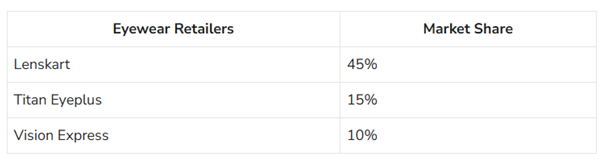
Source – latterly
Lenskart has successfully created aggressive marketing campaigns to reach their target audience and drive brand growth. These campaigns have used different channels that include television, advertising, print media and digital platforms to increase visibility and engage customers. Following an aggressive approach, Lenskart’s performance marketing yielded extraordinary results. The teams at Lenskart optimised their marketing campaigns. Also, their dedication to ensure customer-centric marketing is clear through different promotional deals and targeted advertisements across multiple channels.
Along with television advertising, Lenskart has also explored other avenues of performance marketing, like email campaigns. The company’s well-crafted emails have enabled them to experience a significant increase in online transactions. Overall, Lenskart’s aggressive marketing campaigns proved highly effective in enhancing brand awareness, customer acquisition, and revenue growth. With strategic planning, continuous optimisation and a customer-centric approach, Lenskart has emerged as a leader in the eyewear industry.
Lenskart’s performance marketing strategy serves as a benchmark in the Indian D2C space, utilising data-driven decisions and precise consumer targeting. By utilising omnichannel presence, AI-powered recommendations, and precise customer segmentation, the brand has successfully converted digital intent into offline foot traffic and online sales with remarkable efficiency.
The strength of Lenskart’s performance marketing lies in its ability to personalise communication on a large scale. Whether through retargeting campaigns on social media, paid search ads, or influencer partnerships, the brand consistently delivers messages that connect with the customer’s journey. Moreover, real-time analytics and A/B testing ensure that every marketing rupee is optimised for maximum ROI.
Lenskart’s performance marketing doesn’t stop at acquisition; it extends into retention, with smart loyalty programs, after-sales services, personalised offers, and ease of application use that keep customers coming back.
In conclusion, Lenskart’s performance marketing approach has been crucial in driving exponential growth by blending technology with consumer insight. Its consistent focus on measurable outcomes, cost efficiency, and user-centric strategies has turned it into a case study for digital success. Lenskart’s performance marketing proves that when innovation meets precision, growth is sure to happen.


 August 19, 2025
 October 18, 2018
 October 27, 2018
 November 9, 2018
 December 12, 2018
 January 12, 2019
