Secure Document Management System for Fintech Businesses
The fintech industry is rewriting the rules of financial services. From mobile wallets and peer‑to‑peer lending platforms to blockchain‑based payment systems, fintech companies are reshaping how people interact with money. But with innovation comes responsibility: fintech firms handle vast amounts of sensitive data, including customer identification details, transaction records, compliance documents, and proprietary business information.
A breach in this environment can often lead to devastating financial losses, regulatory penalties, and erosion of customer trust. That’s why a secure document management system (DMS) is no longer optional; it is a strategic necessity. An DMS provides fintech businesses with a centralized, encrypted, and efficient way to store, manage, and share documents. More than just a single digital filing cabinet, it integrates security, compliance, and collaboration into one powerful solution.
Why Fintech Businesses Need Secure Document Management
- Data protection: Financial data is the prime target for hackers. Encryption and access controls safeguard against breaches.
- Regulatory compliance: Frameworks like GDPR, PCI DSS, and local banking laws demand strict document handling. A DMS ensures audit trails and compliance automation.
- Operational efficiency: Manual document handling slows down onboarding, approvals, and reporting. Automation accelerates these processes.
- Scalability: As fintech businesses expand, document volumes multiply. A scalable SDMS grows with the company.
- Customer trust: Secure handling of personal and financial data builds confidence and loyalty among customers.
Key Features of a Secure Document Management System
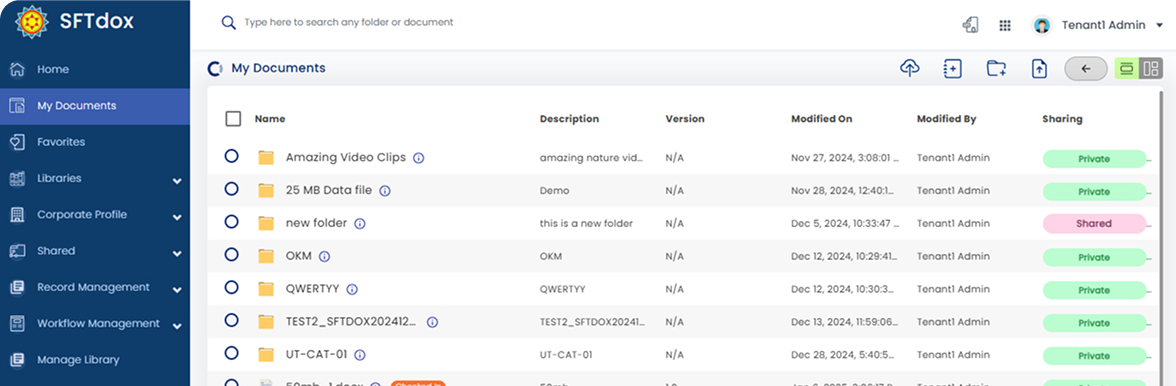
- Encryption: Protects files both at rest and also in transit.
- Access control: Role‑based permissions prevent unauthorized access.
- Audit trails: Comprehensive logs track who accessed or modified documents.
- Cloud integration: Enables secure remote access while centralizing control.
- Version control: Maintains only one source of truth for each document.
- Disaster recovery: Backup and recovery features protect against data loss.
- Workflow automation: Streamlines approvals, compliance checks, and reporting.
- Mobile accessibility: Secure access from the smartphones and tablets supports modern workforces.
- Integration with fintech platforms: Seamless connectivity with CRMs, ERPs, and payment gateways.
Why Is Document Management a High‑Risk Area for Compliance Teams?
Compliance teams in fintech operate under constant pressure to meet regulatory standards while ensuring smooth business operations. Document management becomes a high‑risk area because of several interconnected challenges:
- Volume of sensitive data: Fintech firms generate and store thousands of documents daily, including contracts, customer records, and transaction logs. The sheer volume increases the chance of oversight or mismanagement.
- Complex regulatory landscape: Compliance requirements vary across jurisdictions. A single misfiled or outdated document can trigger penalties or legal disputes.
- Human error: Manual handling of documents often leads to mistakes from mislabelling files to sending sensitive information to the wrong recipient.
- Audit readiness: Regulators demand instant access to accurate records. Without a Secure Document Management System, compliance teams struggle to provide timely, verifiable documentation.
- Cybersecurity threats: Hackers target financial institutions for high‑value data. Weak document management practices expose compliance teams to breaches that can compromise entire organizations.
- Cross‑departmental collaboration: Compliance often requires input from multiple departments. Without centralized, secure systems, documents can be lost, duplicated, or accessed by unauthorized staff.
In short, document management is high‑risk because it sits at the intersection of regulation, security, and operations. A secure Document Management System reduces these risks by automating compliance processes, enforcing access controls, and maintaining audit‑ready records.
Benefits for Fintech Businesses
- Enhanced Security :Cybersecurity threats are escalating. A secure Document Management System provides encryption, intrusion detection, and multi‑factor authentication to minimize risks.
- Compliance Simplified : Fintech firms often operate across borders. An DMS automates compliance reporting, maintains audit trails, and ensures adherence to diverse regulations.
- Improved Collaboration: Teams can securely share documents across departments and geographies. Real‑time collaboration reduces delays and improves decision‑making.
- Cost Efficiency: By reducing manual paperwork, storage costs, and compliance penalties, fintech firms save significantly. Efficiency translates into better customer service and faster innovation.
- Customer Confidence : Trust is the currency of fintech. Customers are more likely to engage with the businesses that demonstrate strong data protection practices.
Implementation Strategies
- Risk assessment: Identify vulnerabilities in current processes.
- Vendor selection: Choose providers with fintech expertise.
- Employee training: Ensure staff understand compliance and system usage.
- Integration: Align DMS with CRM, ERP, and payment gateways.
- Continuous monitoring: Regular audits and updates keep systems resilient.
Challenges in Adoption
While the benefits are clear, fintech firms may face challenges:
- Initial investment: Implementing a DMS requires upfront costs.
- Change management: Employees must adapt to new workflows.
- Integration complexity: Aligning with legacy systems can be difficult.
- Continuous updates: Threats evolve, requiring regular system updates.
Overcoming these challenges requires strong leadership, clear communication, and choosing the right vendor.
Future of Secure Document Management in Fintech
As fintech evolves with AI, blockchain, and open banking, document management systems will integrate predictive analytics, smart contracts, and automated compliance checks. The next generation of DMS will not only secure documents but also provide actionable insights, helping fintech firms stay ahead of regulatory and market changes.
For example:
- AI‑driven compliance: Automated detection of non‑compliant documents.
- Blockchain integration: Immutable records for audit and verification.
- Smart contracts: Automated execution of agreements stored within the SDMS.
- Predictive analytics: Identifying risks before they escalate.
Best Practices for Fintech Firms Using DMS
- Regular audits: Ensure compliance and detect vulnerabilities.
- Strong password policies: Prevent unauthorized access.
- Multi‑factor authentication: Adds an extra layer of security.
- Employee awareness: Training reduces human error.
- Vendor partnerships: Collaborate with trusted providers for updates and support.
Extended Industry Context
Fintech firms are under constant scrutiny from regulators and customers alike. Unlike traditional banks, fintech startups often operate with leaner teams and faster product cycles, which can make them more vulnerable to compliance gaps. A secure Document Management System bridges this gap by embedding compliance into everyday workflows.
Moreover, investors increasingly demand proof of robust security practices before funding fintech ventures. Demonstrating the use of an DMS can strengthen investor confidence and open doors to new opportunities.
Another critical factor is global expansion. As fintech firms enter new markets, they face diverse regulatory landscapes. A DMS provides the flexibility to adapt to different compliance requirements without disrupting operations.
Conclusion
For fintech businesses, adopting a secure Document Management System is a strategic necessity. It ensures compliance, enhances security, boosts efficiency, and builds customer trust.
If your fintech business is ready to take document security and efficiency to the next level, explore tailored solutions at Shyam Future. Their expertise in secure, scalable systems can help you safeguard sensitive data while driving growth.
Take the next step toward secure growth with Shyam Future where fintech businesses find tailored solutions to safeguard documents and accelerate success. Choose SFT Dox and schedule a FREE DEMO now!
Frequently Asked Questions (FAQs)
- What is a Secure Document Management System (DMS)?
A secure Document Management System is a platform that allows fintech businesses to store, organize, and share documents safely. It uses encryption, access controls, and audit trails to protect sensitive financial data.
- Why is document management critical for fintech companies?
Fintech firms handle large volumes of sensitive customer and regulatory data. Poor document management can lead to compliance violations, data breaches, and loss of customer trust. A secureDocument Management System ensures compliance and operational efficiency.
- How does an DMS help with regulatory compliance?
An DMS providesaudit trails, role‑based access, and automated reporting. These features make it easier for compliance teams to meet requirements under frameworks like GDPR, PCI DSS, and local banking laws.
- Can a Document Management System integrate with existing fintech platforms?
Yes. Modern SDMS solutions offerintegration with CRMs, ERPs, and payment gateways, ensuring seamless workflows without disrupting existing systems.
- What are the risks of not using a Document Management System?
Without an DMS, fintech firms face risks such asdata breaches, compliance penalties, inefficiencies in onboarding, and reputational damage.
- Is an DMS scalable for growing fintech businesses?
Absolutely. Awell‑designed DMS is scalable, meaning it can handle increasing document volumes and adapt to new compliance requirements as the business expands.
- How does an DMS improve collaboration?
By enablingdocument sharing across departments and geographies, teams can work together in real time without relying on insecure methods like email attachments.
- What should fintech firms look for when choosing an DMS vendor?
Key factors includesecurity features, compliance expertise, scalability, integration capabilities, and strong customer support.

 August 19, 2025