Artificial Intelligence (AI) is no longer a hyped and futuristic concept confined to research labs or sci-fi movies. It has become a powerful force redefining industries worldwide, and software development is at the forefront of this transformation. From automating repetitive tasks to enhancing decision-making, AI is acting as a catalyst that is redefining the Software Development Life Cycle (SDLC). For any forward-looking software development company in India, embracing AI is no longer an option; it is necessary to remain competitive in this rapidly evolving digital landscape.
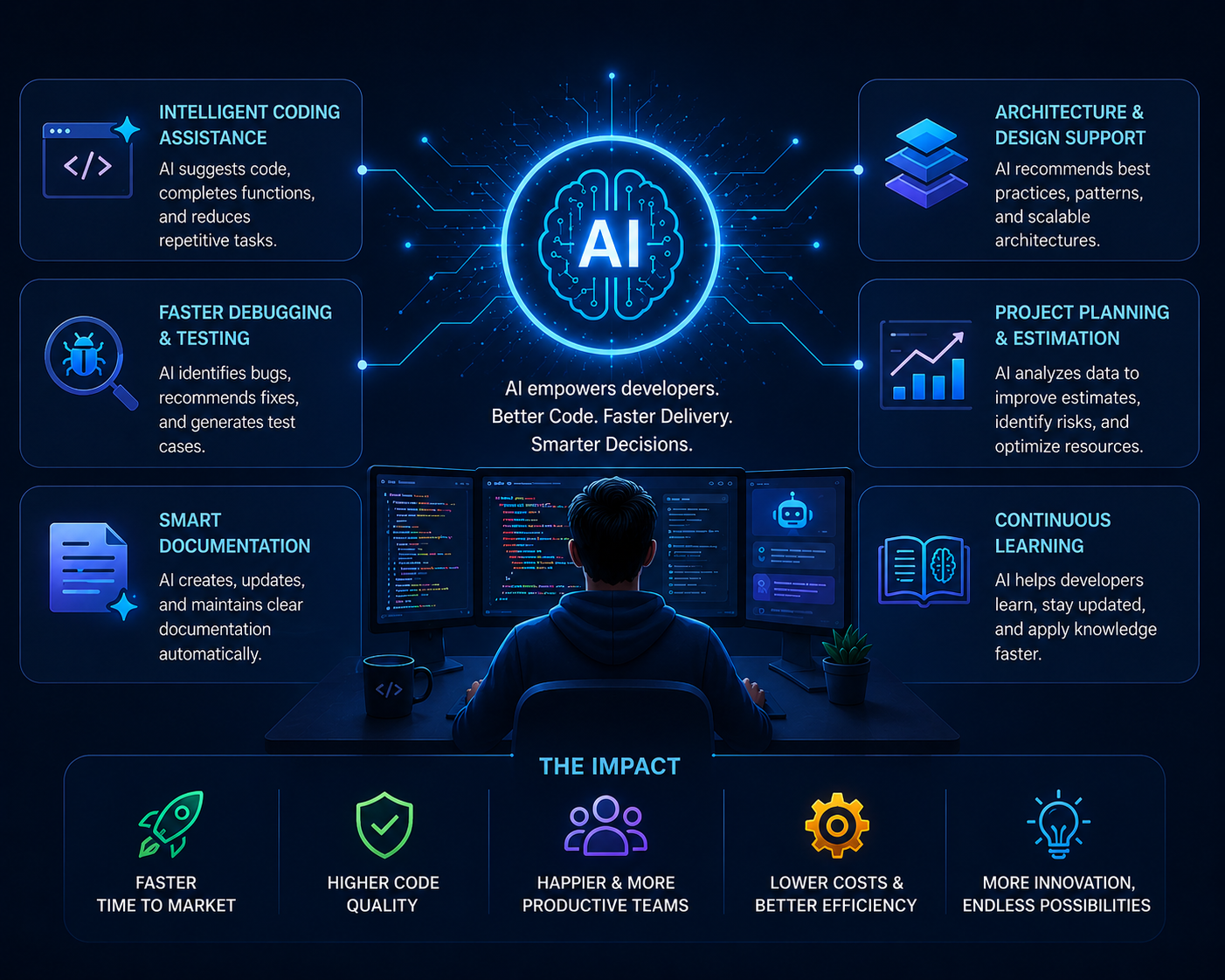
The traditional SDLC encompassing stages such as requirement analysis, design, coding, testing, deployment, and maintenance has long been the backbone of software engineering. However, AI is revolutionizing each of these stages by introducing automation, predictive analytics, and intelligent decision-making.
Requirement Analysis: AI-powered tools can analyze customer feedback, market trends, and historical project data to predict user needs more accurately. Natural Language Processing (NLP) enables systems to interpret human language, making requirement gathering more precise and less prone to miscommunication.
Design: AI-driven design assistants can generate wireframes, suggest UI/UX improvements, and even simulate user interactions. This accelerates the design phase while ensuring user-centric outcomes.
Coding: Intelligent code generators and AI-based Integrated Development Environments (IDEs) can write boilerplate code, detect errors in real-time, and suggest optimizations. Developers can focus on complex problem-solving while AI handles repetitive coding tasks.
Testing: AI-powered testing frameworks can automatically generate test cases, identify bugs, and predict areas of potential failure. Machine learning models can even anticipate future vulnerabilities based on historical data.
Deployment & Maintenance: Predictive analytics helps forecast system performance post-deployment, while AI-driven monitoring tools detect anomalies and recommend fixes before issues escalate.
In essence, AI is not replacing developers; it is augmenting their capabilities, enabling them to deliver higher-quality software faster and more efficiently.
India has emerged as a popular global hub for IT services and software development. With a vast talent pool and competitive pricing, Indian firms have long been preferred partners for global enterprises. However, the rise of AI is reshaping this competitive landscape.
For a software development company in India, integrating AI into workflows offers several advantages:
Companies that fail to adopt AI often risk falling behind, while those that embrace it can position themselves as leaders in the next wave of digital transformation.
Let’s take a closer look at how AI is reshaping each stage of the SDLC:
Consider a software development company in India working on a large-scale e-commerce platform. Traditionally, requirement gathering would involve lengthy meetings and manual analysis. With AI, the company can analyze customer behaviour data to predict features users are likely to demand. During development, AI-powered tools can generate secure payment modules and optimize database queries. Testing frameworks can simulate thousands of transactions to identify potential bottlenecks. Post-deployment, AI-driven monitoring ensures that the platform remains secure and responsive.
This holistic integration of AI across the SDLC not only accelerates delivery but also enhances product quality, customer satisfaction, and business profitability.
The future of software development will only be defined by collaboration between humans and AI. Developers will increasingly rely on AI assistants to handle routine tasks, while focusing on creativity, innovation, and strategic decision-making. AI will also play a critical role in emerging areas such as:
For Indian companies, this represents a golden opportunity to lead the global software revolution by embracing AI-driven practices.
AI is not just transforming software development; it is redefining the very nature of the SDLC. For businesses seeking to harness this transformation, partnering with a forward-thinking software development company in India is crucial.
Shyam Future Tech offers a multiproduct IT suite, SFTWare House, designed to empower businesses with AI-driven solutions across industries. Whether you are looking to streamline operations, enhance customer experiences, or innovate faster, SFTWare House provides the tools you need.
Experience the future of software development. Schedule a FREE DEMO today with Shyam Future Tech and discover how AI can revolutionize your business.
AI automates repetitive tasks like coding and testing, improves accuracy with predictive analytics, and accelerates the entire SDLC. Developers can focus on innovation while AI handles routine processes.
Indian firms operate in a highly competitive global market. By adopting AI, they can deliver faster, more cost‑effective, and higher‑quality solutions, strengthening their position as global IT leaders.
No. AI augments human capabilities rather than replacing them. Developers still provide creativity, strategic thinking, and problem‑solving that AI cannot replicate.
AI generates test cases automatically, predicts failure points, and detects bugs faster than manual testing. This reduces testing cycles and enhances product reliability.
AI‑driven DevOps tools automate deployment pipelines, monitor performance, and recommend proactive fixes. This ensures smoother releases and minimizes downtime.
Partnering with an experienced software development company in India that integrates AI into its processes is the most effective way. Firms like Shyam Future Tech provide AI‑driven solutions through their multiproduct IT suite, SFTWare House.

 August 19, 2025
 October 18, 2018
 October 27, 2018
 November 9, 2018
 December 12, 2018
 January 12, 2019
