When was the last time you used Google or any other search engine, and it instantly gave the accurate answer you wanted? It doesn’t really happen that fast, right? You have to keep searching with related terms and put queries multiple times.
With the increasing use of ChatGPT, Co-Pilot, Gemini, and other such AI tools, things have started to change. What if I tell you that you can get the exact answers to your queries, and you don’t have to use any AI tool for that? Search engines are also evolving. That’s where AEO in digital marketing comes in.
Did you know? By 2025, AI is expected to power 80% of digital marketing strategies. [Gartner]
Think about it. You asked a question in a search engine, and the answer was not only relevant, but it was the exact one you needed. This is possible! We stand at the edge of a revolution that combines human curiosity with AI precision. If you’re not ready, your business will fall.
Voice search accounts for 50% of online queries. It is on the brink of dominating the online queries. [Elsner].
AI tools like ChatGPT are evolving faster than we can think. There is no denying that traditional SEO is no longer the way to get ranked on search engines. SEO shares the stage with AEO (Answer Engine Optimization) and GEO (Generative Engine Optimization). AI-driven search engines are the future. If you ignore them, you will also ignore your success.
Now, the question is, why is traditional SEO not enough? The reason is that AI-driven digital marketing strategies have completely changed the game. How? From local SEO tactics, businesses these days have moved towards advanced AI-powered marketing.
Whether you are an e-commerce brand seeking E-commerce SEO tips or a company optimizing for content strategies, AEO, GEO, and SEO will redefine how you can reach your audience.
Also Read: How Lenskart Performance Marketing and Technology Helped Scale Up Its Business
AEO focuses on offering quick and accurate answers. With tools like Google Knowledge Graph, users want immediate results. Voice assistants like Alexa and Siri have increased this demand.
Instead of going through websites, we ask direct questions. AEO in digital marketing helps your content reach featured snippets or voice search results. It offers the users what they need instantly.
To implement AEO effectively, it is crucial for the business organization to understand its audience. The next step is to organize data and continually refine the content. The crucial steps include keyword research, using structured data markup, and optimizing content for voice search.
For any business, it is crucial to increase visibility by formatting the content according to the snippets. Content formatted as tables, lists, or short answers is ranked higher. Search engines use this data to provide answers to queries. Tracking the featured snippets offers insights into the performance of your AEO strategy. It will also improve the visibility of the FAQ page. We will soon discuss the importance of FAQ pages in AEO.
Voice assistants, such as Alexa, Siri, and Google Assistant, rely on natural and conversational language. Thus, for a business to optimize for voice search results, it must use phrases that sound human. Additionally, it should align with how people ask questions.
The voice of your content must match the conversational tone and sentence structure of voice queries. Voice assistants encourage users to ask questions in full sentences. Therefore, it is essential for your content to adopt a conversational tone. This approach not only matches the natural language used in voice queries but also enhances readability and user engagement.
Also, adding “near me” and location-based queries helps in improving your local SEO. Thus, your business becomes easily discoverable to others seeking information about nearby services or products. Also, when you secure a spot in Google’s featured snippets, it improves the credibility of your brand.
Content example for Voice Search
| Question pattern | Sample queries | How to optimize
|
| Informational questions | “how to cook chicken” | Add step by step instructions instead of paragraphs.
|
| Local questions | “Chinese restaurant near me” | Focus on local SEO tactics |
| Comparison-based questions | “Best SEO tools vs. AI tools” | Using tables for comparing options. |
When you add structured data to your website, it gives search engines a clear understanding of your content. Schema markup highlights crucial details, such as reviews, FAQs, and events. Thus, it becomes easier for search engines to fetch relevant data and display it to visitors.
Schema markup helps contextualize your content. Since it becomes easier for search engines and AI to interpret, it improves the chances of your content being ranked in quick response formats, such as featured snippets.
Schema.org offers structured data for different types of content. This includes FAQ, How-to, and Q&A questions. Adding these types of structured data can improve the content’s visibility in search results.
This is highly crucial for AEO. You can use tools like Google Keyword Planner, Moz, Semrush, or Spyfu to figure out the relevant and popular queries in your domain. Also, you can use the Google Search Console dashboard to attain valuable insights into how the content is performing in answer-based searches.
While seeking keywords, you can use modifiers like “what is” or “how to”. This will help you to understand the user intent in a much better way. Also, adding generative AI to provide custom responses based on user inquiries can enhance the effectiveness of the AEO strategy.
This is another aspect of AEO in digital marketing. Just as with SEO, to optimize for AEO, it is crucial to create high-quality content. Ensure the content addresses user queries with clarity and accuracy. The content must be well-researched, informative, and highly specific to meet the needs of your target audience.
Add relevant keywords naturally in the text to align it with the search engine and answer engine algorithms. Ensure that the content is clear and easy to understand. Use bullet pointers, headings, and subheadings with short paragraphs to improve readability. These are the basics of content creation for AEO, just as they are for SEO.
Source – Eflot
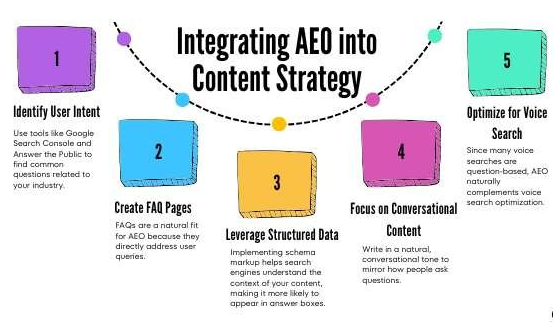
Now, what makes the content for AEO in digital marketing different than the content for SEO? The structure of the content affects how the Answer Engines process it. Formatting the content is very crucial. It gives the overall content machine-readable information that the AI can quickly extract. Here is what a good AEO-formatted content includes:
This is also part of AEO’s content creation strategy. FAQ pages are powerful tools for AEO marketing. They include well-structured, to-the-point question answers that Answer Engines can process quickly. FAQs match how users ask questions, and they work better than traditional content. Here is what you can do with your FAQ page.
When creating content specifically for AEO, remember to find the right balance between concise and detailed answers. It will be tempting to overexplain things. Try to sum up answers in a short paragraph. Not just AI, but human readers also prefer this approach.
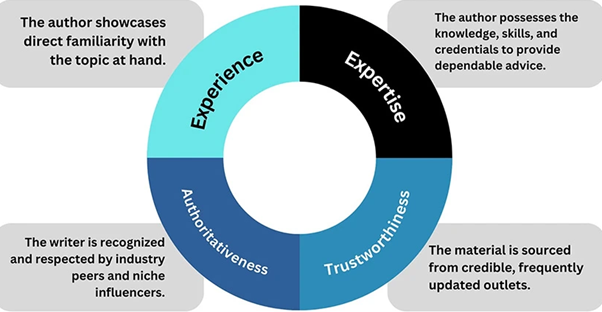
It is crucial to establish expertise, experience, authoritativeness, and trustworthiness (E-E-A-T). Let us explain what E-E-A-T principles are. The four elements of E-E-A-T are essential for building credibility and improving your content’s ranking in search engines.
In Norwegian, E-E-A-T can be referred to as:
To improve E-E-A-T, companies must:
Source – mementor.no
So, if you notice carefully, the importance of AEO in digital marketing is as much as it was for SEO in digital marketing. Why? AEO in digital marketing enables businesses to appear in direct searches and voice queries. The objective of using AEO strategies for any business is to offer a search generative experience (SGE) faster than its competitors.
Also Read: Local SEO Services in India: Why It’s Crucial for Small Businesses Today
Google’s featured snippets (powered by AEO) receive 8.6% more click-through traffic than regular organic results. [Creator.ai]
Answer Engines are not like the traditional search engines. Answer Engines focus on delivering clear and concise answers that are relevant to the user queries. This focused approach makes AEO a vital strategy for businesses seeking to enhance online visibility and user engagement.
Answer Engines utilize advanced AI and natural language processing to accurately interpret user intent and provide precise answers. With such a shift from keyword-driven searches to using ML and natural language processing, the way users receive information has improved.
The types of Answer Engines:
Primarily, there are two types of answer engines. They are:
1. Generative AI bots
2. AI-powered voice search assistants
Generative AI bots offer human-like responses and engage in conversations. This makes them highly effective for user interaction. On the other hand, AI-powered voice search assistants can respond to queries using voice-recognition technology, ensuring hands-free access to information. These assistants, such as Alexa and Google Assistant, utilize AI and natural language processing to deliver relevant and accurate answers to user queries.
With the rise of voice search and AI, the need for AEO has increased. Users expect quick and immediate responses to their queries. The shift from keyword-based searches to conversational phrases led to the rise of Answer Engines.
It serves up answers in real-time without needing any user clicks. People these days want faster and accurate information. The rise of Generative AI Chatbots and AI-powered voice search assistants has made it possible to meet the demand efficiently.
We had mentioned zero-click search results earlier. Users want to get answers without having to sift through chunks of information. Here are some more statistics on zero-click search results.
There is no denying that such a significant shift from search engines to answer engines directly affects traffic patterns. US organic click-through rates dropped from 44.2% to 40.3% in just one year. These changes resulted in a 15% to 25% reduction in overall organic web traffic.
As a business organization, if you don’t adapt to the Answer Engine optimization trends, there is a high chance that your business might become invisible in the near future. Even users who doubt generative AI tend to get the most accurate answers on the search engine results page.
It is crucial to monitor performance metrics to ensure that AEO strategies remain relevant and effective over time. In this section, we shall cover the key metrics to track and use iterative content improvement to keep AEO strategies in digital marketing relevant.
Just like SEO, there are certain factors and metrics that you need to track to understand how your AEO strategies in digital marketing are performing. The key metrics include organic traffic, click-through rates, and engagement. These indicators demonstrate the effectiveness of your AEO strategies and provide insights into areas that require improvement.
Utilizing analytics tools and monitoring platforms is essential for effective performance tracking. Monitor the content’s performance regularly. It will help in adapting the changes in user queries and search algorithms. It helps to ensure that your AEO remains relevant and effective.
Iterative content improvement focuses on the importance of regular updates to your content. This must be done to align the content with the changing user behaviour. When you monitor and refine the content, it helps ensure that the content addresses user queries and engages the audience. Make sure to follow user feedback. It helps improve engagement and satisfaction while also enhancing AEO performance.
Yes, AEO can help lower bounce rates. When your content directly answers user questions, visitors quickly find the information they need. This encourages them to stay longer on your website, explore more pages, and engage with your brand. AEO focuses on providing value upfront, reducing the chances of users exiting your site without taking action.
Traditional SEO focuses mainly on keyword optimization and backlink building. AEO in digital marketing, however, focuses on answering direct user questions with clarity and precision. It goes beyond keywords by targeting search intent, which improves the chances of being featured in quick answer sections, rich snippets, and voice search results.
Not always. You can update your existing website pages by adding question-based headings, concise and clear answers, and structured data markup. AEO in digital marketing works best when you naturally integrate answers into your content without making it look forced or repetitive.
Many businesses make the mistake of focusing only on adding random questions without providing useful answers. AEO in digital marketing is about providing high-quality, relevant information. Ignoring user intent, skipping structured data, or failing to update outdated answers can all prevent your content from ranking effectively.
This happens when the content is too vague or fails to address the specific needs of searchers. AEO in digital marketing rewards precision and value. If your answers are too short, lack clarity, or miss key details, Google may choose other sources. Regularly updating your content and monitoring search trends is key.
A cluttered webpage with poor headings and scattered answers can confuse both users and search engines. AEO in digital marketing relies on clean, organized content where questions are clearly stated and answers are easily accessible. Bad structure can lead to lower rankings and a poor user experience.
Internal linking guides search engines through your website, helping them understand the context of your content. When you use AEO in digital marketing, linking related answer-based pages boosts your site’s authority and increases the chances of ranking multiple pages for different queries.
Yes, absolutely. AEO in digital marketing helps level the playing field. By answering niche, location-based, or product-specific questions, small businesses can target highly focused search queries that big brands often ignore. This increases visibility and builds trust with local customers.
Definitely. Google prefers fresh, relevant answers. Regularly updating your FAQ sections and informative blogs ensures your AEO strategy stays effective. Outdated answers can lead to a drop in rankings and fewer appearances in rich results.
Yes, industries offering complex products or services can use AEO in digital marketing to simplify explanations for potential customers. By breaking down technical topics into simple Q&A formats, businesses can attract both beginners and experts, improving traffic and engagement rates.
As we have mentioned in the earlier section of our blog, Search Engine Optimization improves the website’s ranking in the search results. On the other hand, AEO helps secure spots in special answer formats, such as featured snippets and voice search results.
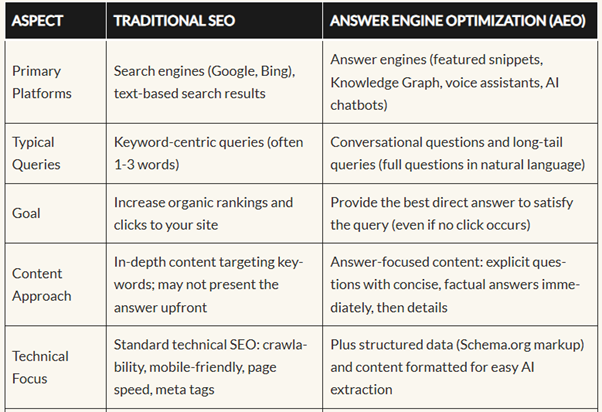
Answer engines focus on clear and simple responses. AEO helps businesses increase their online visibility and engage users more effectively. Let’s delve into more details of the differences between AEO & SEO.
SEO focuses on your website getting indexed through a wide array of keywords. The objective of SEO is to get more visitors to your website through search engines.
AEO provides quick and direct answers to specific questions. It helps your content appear in featured snippets, voice searches, and other concise formats.
SEO utilizes strategies such as conducting keyword research, building a link profile, and optimizing site speed to enhance rankings. Optimizing the titles, meta descriptions, and content for targeted keywords.
AEO in digital marketing focuses on using natural language, structuring content clearly, and adding elements like FAQs or lists that help answer questions directly. It also depends on the schema markup to make content easily accessible and understandable.
With SEO, the content is designed to cover multiple topics. It also includes related keywords to help you rank for multiple search terms.
On the other hand, the content for AEO is much more specific and precise. It aims to deliver clear and simple answers. This means using short paragraphs, bullet points, and clear explanations that align with the users’ queries.
SEO targets keyword-based searches. Users type in specific keywords or phrases.
AEO prioritizes understanding the intent behind the queries. It focuses on conversational or natural language queries, such as those spoken to voice assistants. This shift needs the content to align more with how people speak and ask questions.
Source – CXL
SEO and AEO in digital marketing can work together to create a more effective and user-centric strategy. While SEO focuses on optimizing content for search engines through the use of keywords, backlinks, and technical improvements, AEO (Answer Engine Optimization) is designed to provide direct, concise answers to user queries, particularly for voice search and AI-driven platforms.
The importance of AEO lies in its ability to quickly and clearly meet user intent. When combined with SEO, it enhances the overall effectiveness of your digital strategy.
Also Read: How Spotify Used Data-Driven Campaign & Regional Curation to Expand in India
The importance of AEO becomes clear when combined with SEO. As search engines evolve to prioritize user intent and conversational queries, combining both strategies ensures your content remains competitive and accessible.
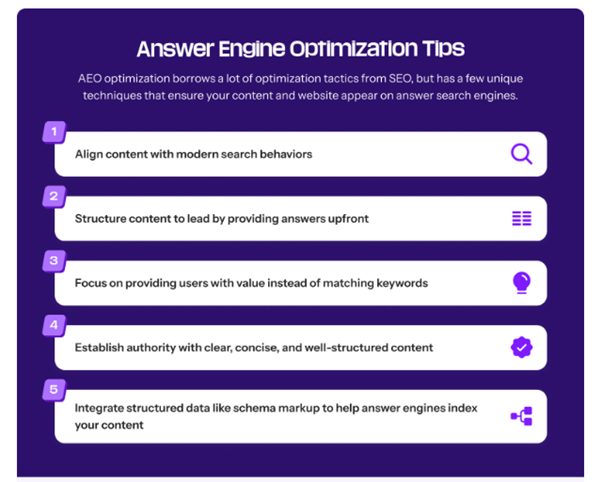
Here are the key benefits of integrating SEO and AEO in digital marketing:
Source – seo.com
The importance of AEO is growing rapidly, especially as users shift toward instant, voice-driven search experiences. By aligning it with SEO, businesses can create content that not only ranks well but also delivers value in the moments that matter most.
In short, SEO helps your content get found, and AEO in digital marketing helps it get featured. Together, they drive visibility, engagement, and trust, making them essential tools in any modern digital strategy.
With AEO getting prominence in digital marketing, businesses are rushing to optimize for clear and concise answers. However, there are certain challenges to stand out in Answer engines. Here they are.
Not many websites focus on featured snippets and top answer selection. Thus, it is highly competitive to be a part of them. Competition is increasing for specific terms and queries. Similar content is getting created.
This increases the need for quality answers. This is why if you are planning to create content for AEO in digital marketing, you shall face high competition to get the content placed on the featured snippets of search engines.
For AEO, it is crucial to have clear yet brief responses, as these are easy to understand. Also, it provides sufficient information that caters to the user’s search purpose. Now, a crucial aspect of oversimplification is that the value of the content can be lost. Also, over-explaining the content can cause difficulties in selecting snippets. Therefore, ensure that the content is balanced and well-informed. It can be challenging sometimes. But that’s the strategy you have to follow.
Most of the search engines change their algorithms periodically. This is to suit the cause of the user. In simple terms, it is essential to be aware of these changes and adjust the approaches to ensure that the content is properly organized and updated regularly.
AI platforms like ChatGPT cite the most-cited articles and journals. They mostly depend on Google Scholar’s citation counts. Therefore, AI might enhance the Matthew Effect. It is a phenomenon where well-established research and authors get more visibility while new or less-cited work struggles to gain traction.
It is crucial to measure the impact of AEO. However, measuring the effectiveness of AEO becomes challenging due to the limited analytics on where and how the content is utilized in Answer Engines.
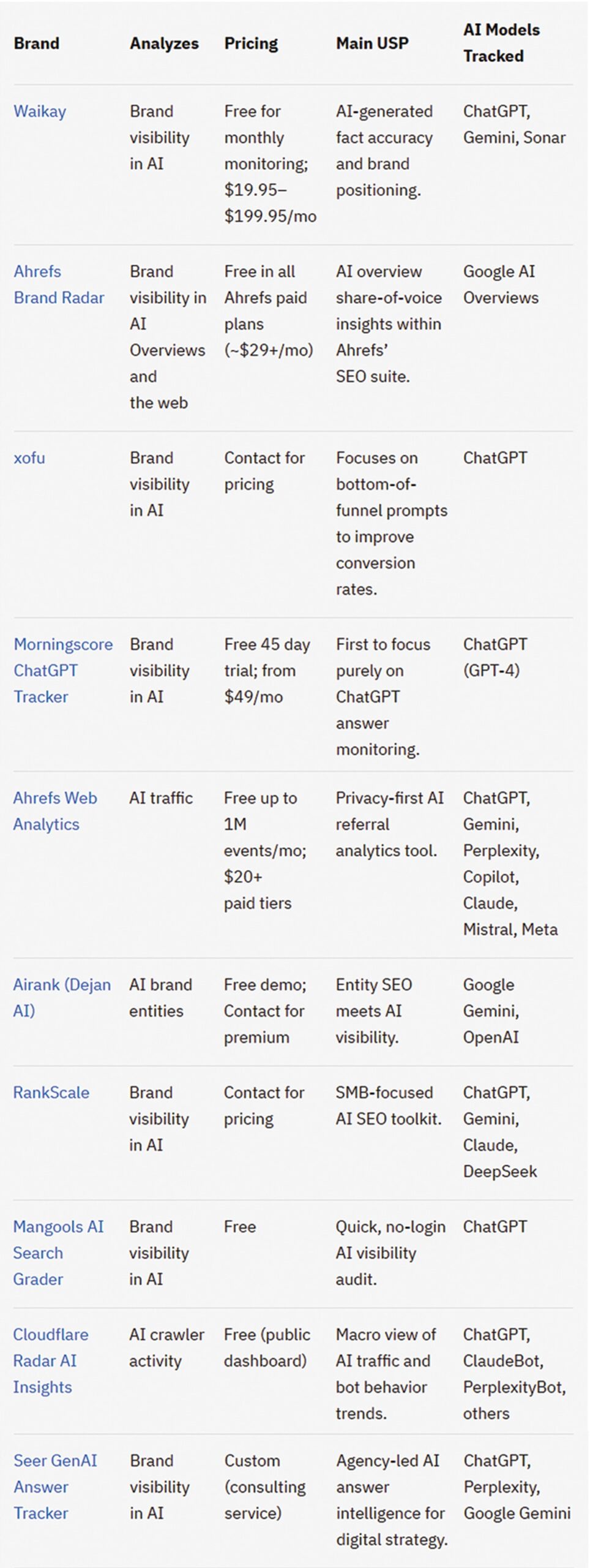
If you can successfully optimize your way into the AI response, it will not be difficult to lead the adoption curve. Here are the top 10 AEO tools that can help you get there.
This is one of the best AI tools for AEO in digital marketing. The tool builds a knowledge graph for your brand and then compares it with what the LLMs understand about you. The best part is how it tackles misinformation. Waikay extracts specific facts that LLMs assert about your brand and then lets you flag the incorrect ones. This acts as an internal reminder to take further action and then resolve the inaccuracy. This is crucial for reputation management.
Features
It helps track your brand in Google’s AI overviews across the wider web – both factors will impact your visibility in AI platforms. The competitive share trend visualization is crucial for showing which brands are dominating AI conversations in specific topics.
Features:
One of the crucial elements that differentiates Xofu from other AEO tools in digital marketing is that Xofu delves deeply into a specific critical area – the bottom funnel buyer prompts. Xofu tracks when ChatGPT recommends your brand in high-intent purchase scenarios – these are the moments when real revenue is at stake.
Features:
Instead of telling you if the brand appeared, Morningscore captures excerpts of prompt responses on a weekly basis. It is a simple AEO tool. Just like most of the AEO tools on this list, you have to enter the brand/competitors to start tracking. Unlike most other tools, you must manually input your own prompts. The setup is a bit more time-consuming.
Features
Ahrefs Web Analytics is a cookieless, free, and user-friendly alternative to GA4. It is also a great LLM optimization tool. Ahrefs Web Analytics does not categorize AI traffic as “referral” sources. It will categorize LLM visitors in a distinct channel, showing the pages that receive actual traffic from ChatGPT, Perplexity, or other assistants.
You can use the reports to determine which content type consistently receives more AI clicks. It will help you plan and prioritize your AEO efforts, delivering measurable results.
Features:
This tool maps the semantic relationships between your brand and other entities in AI knowledge graphs. It utilizes DEJAN methods to query the LLM on a weekly basis, focusing on both “brand-to-entity” and “entity-to-brand” relationships. This is about checking how AI conceptualizes your brand, not just where it mentions you. Other than the brands, it can track people’s names, products, services, and events.
Features:
This is a Generative Engine Optimization (GEO) platform designed to analyze, track, and optimize brand visibility through AI-powered search engines. This AI not only tells you where your brand appears but also evaluates how the AI crawlers perceive your site, analyzes citation sources, monitors sentiment, and offers actionable recommendations for improvement.
Features:
Mangools created an entry point into AI search optimization. The AI Search Grader offers you a simple 0-100 score across multiple LLMs without any major investment.
Features:
Cloudflare Radar approaches AI optimization from a completely different angle. It focuses on the crawlers themselves, rather than just the outputs. It was launched in February 2025 and offers you visibility into which AI bots are accessing the content, how they are treated by robots.txt, and the overall crawler traffic patterns. If you are doing technical SEO for your brand, this data is pure gold.
Features:
Seer Interactive’s GenAI Answer Tracker is a custom report that you can request to be created for your brand. It was developed after their fascinating research on the correlations between SEO strategies and LLM visibility. After analysing 10,000 AI responses, they developed a report that quantifies which websites are mentioned the most by the AI. It monitors the questions and topics associated with your brand throughout the LLM’s answers.
Features:
Source – Ahrefs
The future of AEO in digital marketing is closely tied to emerging trends in AI-driven search, visual search, and advanced Natural Language Processing (NLP). Robots are answering queries these days. Thus, accuracy and conversational tone are crucial.
Also, visual search is becoming popular. This means it requires proper visuals and their metadata to be highly relevant. Semantic search improves the understanding of the subject matter and user motives. Therefore, it helps in converting high-quality content for utility-driven users.
In the coming years, AEO in digital marketing will be a crucial player. With high competition, businesses must create focused content that is ready to answer queries. To meet user expectations of speed and precision, AEO is presenting a positive image that being helpful will ensure the brand’s endorsement on social media platforms.
In simple terms, it’s time to start improving your website. Focus on AEO right now and don’t lose your opportunities to rank for featured snippets, improve your CTR, and enhance the user experience.
Source – seo.com
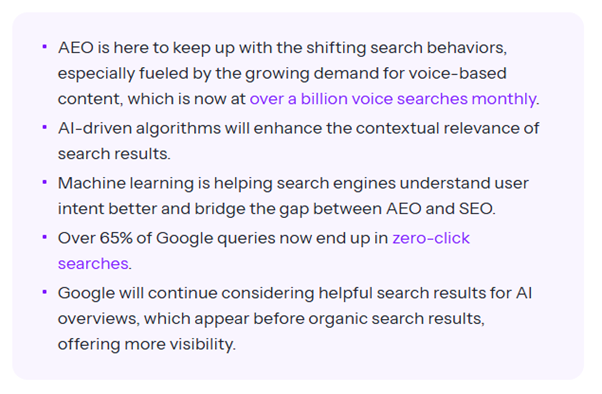
The future of AEO in digital marketing is full of new opportunities for businesses. As search engines become smarter and more focused on user intent, brands must adapt their content creation and sharing strategies. AEO is not just about ranking on Google anymore. It’s about providing fast, direct, and helpful answers to users across multiple platforms, including voice assistants and AI chatbots.
Businesses need to focus on building clear, structured, and helpful content. Answering user questions directly, utilizing FAQs, and including schema markup will help websites get featured in AI-generated search results. Voice search is also growing fast, so it is important to create content using natural, conversational language. This way, brands can show up when people search by speaking instead of typing.
Another important part of AEO in digital marketing is optimizing for zero-click searches. Many people now get answers from Google’s answer boxes, featured snippets, and AI summaries without clicking on any website. By focusing on these areas, businesses can stay visible even without getting direct clicks.
Adding short videos, infographics, and visual answers will also become important. People want to receive answers quickly and visually, so brands that use more media will have a better chance of ranking in answer engines. Location-based searches are also on the rise, so local businesses must improve their AEO strategies.
In short, AEO in digital marketing is evolving rapidly, and brands must stay updated with these trends. Companies that focus on providing fast answers, using voice search, utilizing AI-generated results, and adding visual content will be more successful. The businesses that adopt AEO now will build a stronger online presence and gain more trust from their customers in the years ahead.


 August 19, 2025
 October 18, 2018
 October 27, 2018
 November 9, 2018
 December 12, 2018
 January 12, 2019
