
The brand ‘Tropicana’ was founded in the year 1947 in Bradenton, Florida. It was initially a processor of fresh fruit segment by Anthony Talamo Rossi. He founded the company intending to bring to Floridians the same kind of fresh orange juice found in his homeland. Gradually, Rossi began producing frozen concentrate of orange juice in 1952 and branded them as ‘Tropicana Pure Premium.’ In 1954 Tropicana engineered to develop flash pasteurization, a process that preserved the fresh taste and flavor of the juice. The method uses a lower temperature than regular pasteurization but heats the liquid for a more extended period.
Rossi now had a product that distinguished his company from its competitors, so he soon stopped offering Tropicana in frozen concentrate form. In 1957 he changed the company’s name to Tropicana Products, Inc. to reflect the brand’s increasing popularity. In 1978 founder Rossi retired, and the company was sold to the Beatrice Company. PepsiCo later acquired the company in 1998. In 2021, PepsiCo sold 61% of its stake in Tropicana to PAI Partners, a private equity firm, and retained the remaining 39%. Today, Tropicana Products, Inc. is a division of PepsiCo, Inc., the leading producer, and marketer of branded fruit juices.
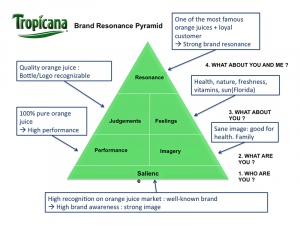
Have you ever thought about which strategy best helps a famous brand company reach consumers? Let us discuss the Marketing Strategy & Mix of Tropicana to understand its product, pricing, advertising & distribution strategies. For this, we need to cover the 4Ps of Tropicana’s marketing mix:
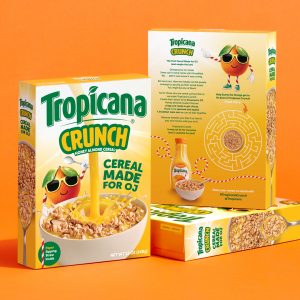
Tropicana mainly specializes in orange juice but has several other flavors like mango, apple, grape, guava, and cranberry. It currently has 70 different juice varieties and offers smoothie products in its marketing mix. Some of its popular products are:
The significant aspect of the brand’s products is that it selects the best fruit to manufacture the best quality juices deeply rooted in the ethos of the company since its birth. It also developed innovative processes to ensure superior quality and explored new markets and territories for its products. Tropicana mainly aims to help consumers maintain a healthy lifestyle by ensuring that its products are naturally nutritious and provide an individual’s daily nutrient requirements. Thus, freshness is the guiding principle of branding and packaging and positions itself as a leading breakfast beverage.
Tropicana’s products are costlier than similar products its contemporaries offered because they use the best quality fruits and produce high-quality juices with innovative processes. But, the price of Tropicana products is not too high, and they can be consumed by middle-income group families daily. For example, in the Indian market, the 200 ml tetra pack is priced at INR 20, while the 1000 ml tetra pack is priced at INR 100. It also offers value packs, a combination of 3 different flavors in 1000 ml tetra packs, each priced at INR 360 according to Indiamart. In recent years, Tropicana’s sales have increased as more people have become health conscious and prefer consuming healthy fruit juices instead of synthetic and carbonated drinks.
Since the late 1980’s Tropicana has grown tremendously by diversifying its product range and extending its geographical boundaries of the United States. Tropicana is headquartered in Chicago and has its products sold in many countries worldwide, including the UK, Canada, Ireland, Germany, France, Argentina, Japan, and the Panama region. After the 1990s, Tropicana expanded internationally in Latin American countries and Asia in Hongkong, China, and India. Today, Tropicana products are everywhere, from supermarkets, grocery stores, convenience stores, and general and provision stores.
The product mainly targets the urban youth aged 21-35 years and the population above 50 years as this segment of consumers is most health conscious and values quality over the product’s price. They can also distinguish between good packaging vs. bad packaging and determine if a product appeals to them or not. It is consumed in urban cities much more than in smaller rural areas. With the emergence of global eCommerce platforms like Amazon, Walmart, Alibaba, etc., it became much easier for consumers around the globe to avail its products. Tropicana is also available in India on Bigbasket, Reliance Fresh, Blinkit, Flipkart Groceries, etc.
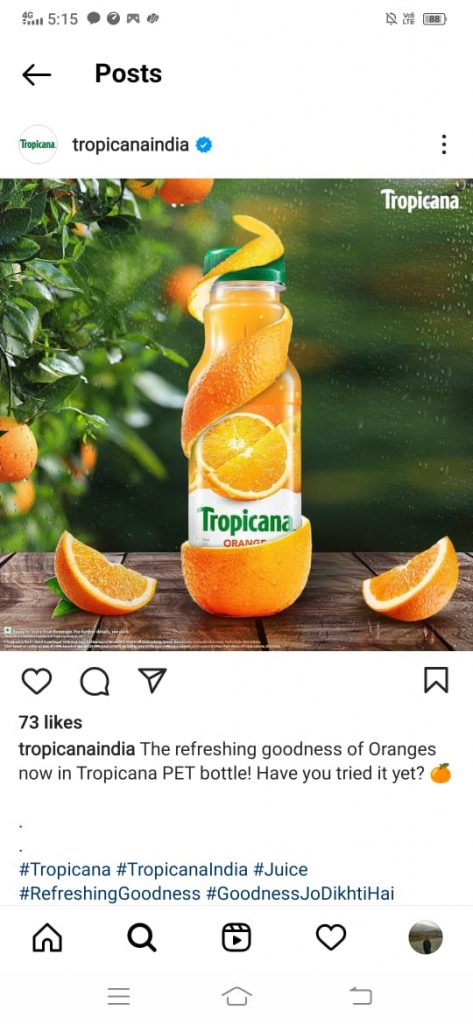
Tropicana promotes its products through a complete marketing cycle that includes a well-defined conventional and digital marketing strategy. It employs television commercials and print media ads and actively engages in social media platforms like Facebook, Twitter, Instagram, LinkedIn, and YouTube.
Tropicana on FB: https://fb.watch/eh2JeyWkdW/
YouTube: https://youtu.be/AHx5iHDc8jc
Instagram:
It also carries out promotions in supermarkets by setting up stalls and offering the customers free samples whenever they introduce a new product, thereby increasing product awareness. In addition, the target market of Tropicana includes health-conscious people, so the brand also advertises in lifestyle and health magazines likely to be read by such a segment. The company has also launched various campaigns. One such campaign, for instance, is the ‘It’s good to be alive’ campaign, kick-started in India.
It’s a global campaign that shows that when you add Tropicana 100% to your mornings, you will have a great start to your day. The campaign emphasizes motivating the viewers to have a healthy beginning to their day.
The brand also sponsors various sports and cultural events promoting the importance of a healthy lifestyle, which aligns with its product. There is also a sports stadium named after Tropicana called the Tropicana Field Stadium. It is located in St. Petersburg, Florida, and hosts baseball games, sporting events, and concerts. In addition, the stadium has an entertainment center, shopping plaza, and a food court where many Tropicana products are offered for sale. Tropicana also participates in health awareness programs to educate children.
The market segmentation strategy adopted by Tropicana is brilliant as it tries to reach the highest profit levels for the company. It targets the health-conscious segment of consumers and smartly emphasizes the brand’s USP that its juices are 100% natural! This segment, under the demographics, targets all age groups of consumers with particular attention to the ‘breakfast-conscious’ middle and higher income groups. It also subtly poses as a healthier alternative in place of caffeinated and carbonated beverages.
A few years ago, in 2009, Tropicana went on a rebranding journey that led it to change its packaging. The brand moved from the old Tropicana logo of straw inside an orange into a sleeker design with lots of white space. This emerged as one of the major packaging failures in the history of brands. The company that spent $35 million in marketing incurred a loss of $20 million within a month of rebranding!
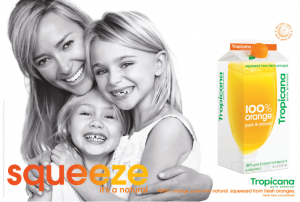
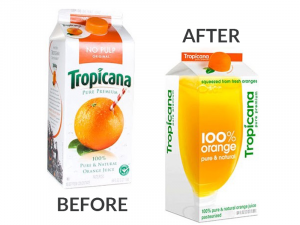
No matter how great your juice is, you can’t force your customer to tilt their head sideways in the grocery store to read the name. The logo rebranding presentation was also faulty as it moved to the right from bold, centered, and horizontal — easy to read! The brand failed to understand the simple yet crucial aspect that a majority of consumers read from left to right, and with the new rebranding, the brand’s biggest visual appeal- its logo and brand name lost focus.
Although Tropicana’s new packaging launch campaign was meant to be a game changer for the brand, it came to be considered as one of the famous examples of brands with bad marketing strategies that could be a jolt to their success rides. For this reason, Tropicana had to face disapproval from their loyal customers, and they pulled the new design off the shelves and returned to the old one. Unfortunately, Arnell, the ad agency they had hired for this massive rebranding, closed after four years despite being there for three decades in the business. Here are a few lessons that Tropicana learned in the process and also for marketing enthusiasts to take home:
Although Tropicana had hired a famous ad agency named Arnell in 2008 to carry out this rebranding exercise, it failed massively. Rebranding can be a strong marketing tool as it allows brands to reinvent themselves. However, it need not be drastic. Also, thorough market research is fundamental to understanding the target audience’s perspectives involving the brand.

If your brand is known for a specific image, logo, color, or theme, don’t remove it. You don’t want your brand to become unrecognizable. Instead, try small, subtle and appealing tweaks centered around your existing design elements. Tweak your designs subtly instead of completely changing what you have.
Every loyal customer has an emotional connection with its brand. Your rebranding exercise should not seem like a ‘disconnect’ from it. They can feel betrayed if they suddenly can no longer identify with new brand packaging design. It is essential to always consider this before making changes to packaging designs.
Packaging should differentiate your product from other brands with similar products. The new package design with more white space and lack of visuals failed to impress the consumers. It looked washed out, generic and indistinguishable, making Tropicana look like a discounted store brand.
The original packaging clearly stated “no-pulp,” almost like a statutory warning on the box. The new did not emphasize this crucial information. Communicating the correct information to your audience in a simple way to understand – should be the goal of a design.

Tropicana’s original packaging had rich colors and a strong visual hierarchy. On the other hand, the new packaging with clean lines and a lack of visuals failed to impress the consumers. This transformed the once indistinguishable orange juice into a “generic brand” available anywhere. This case study shows the massive impact design can have on a company. It can impact growth and drive sales in a positive direction when done right with great thought. But the opposite can happen too. Therefore, brands should always give due weightage to design and not underestimate customers’ deep emotional bonds.
The takeaway for marketers, advertisers, and brand strategists should be to have greater respect for packaging design. It’s important to commit to leveraging this brand asset with a systematic procedure. This will ensure consumers accept the change positively!

 August 19, 2025
 October 18, 2018
 October 27, 2018
 November 9, 2018
 December 12, 2018
 January 12, 2019
